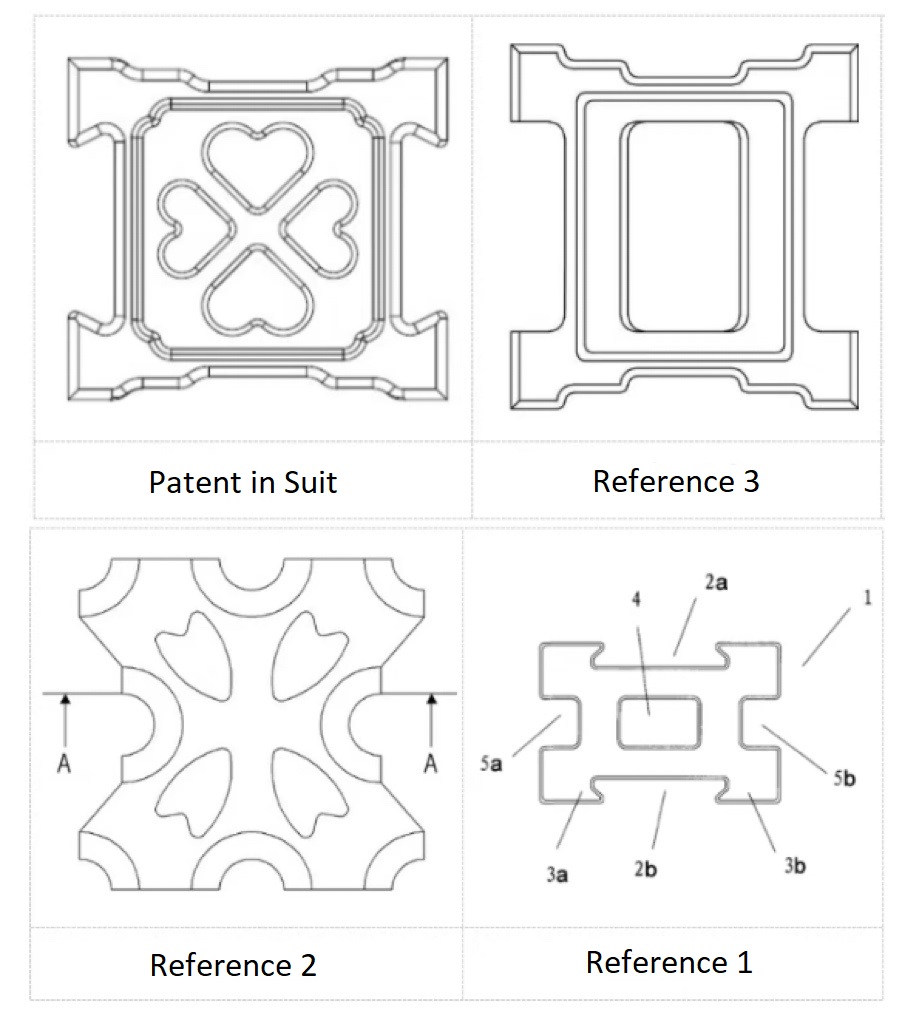
The Supreme People's Court concluded an appeal in an administrative dispute concerning the invalidation against a design patent. With respect to the specific question of how to determine whether a design patent has an obvious difference when compared to a combination of prior art design features, the Court made clear that arbitrarily extracted points, lines, or surfaces are generally not considered prior art design features eligible for combination. If the corresponding parts of the designs already show significant differences, then it serves no practical purpose to assess whether a teaching for combination exists. Furthermore, if the particular manner of combination exceeds the knowledge level of ordinary consumers and their understanding of the relevant product, it should generally be considered that there is no teaching for combination.
The case involved a design patent (see attached drawing at the end of the article). The patentee was Company A. In response to invalidation requests filed separately by Company B and Company C, the CNIPA issued a decision finding that using the four heart-shaped holes from prior art reference 2 and the dovetail groove from reference 1 to replace the corresponding design features in reference 3 clearly provided a teaching for the combing the means. The CNIPA further found that the patent in suit did not have an obvious difference compared to the combined design, and therefore declared the patent entirely invalid.
Company A filed a lawsuit with the first instance court, arguing that the dovetail groove in reference 1 and the four heart-shaped holes in reference 2 could not be considered design features eligible for combination with other prior art designs or design features, and that the differences identified by the CNIPA were not minor local differences but rather obvious distinctions.
The first instance court affirmed the CNIPA's reasoning and dismissed Company A's claims. The court held that the patent and the design after combination were substantially consistent in terms of connection structure, overall shape, through-hole configuration, and other aspects. The overall shape, as well as the shape, relative position, and relative proportion of each main part, were highly similar, resulting in a highly similar visual effect. The differences were either minor local variations or conventional design choices. Based on the principle of overall observation and comprehensive assessment, the similarities between the patent and the combined prior design had a more significant impact on the overall visual effect.
Company A, dissatisfied with the decision, filed an appeal.
The Supreme People's Court, on second instance, annulled the previous ruling and maintained the validity of the patent.
The Court held that arbitrarily extracted points, lines, or surfaces are generally not considered prior art design features eligible for combination. If the corresponding parts of the designs already show significant differences, then it serves no practical purpose to assess whether a teaching for combination exists. If the particular manner of combination exceeds the knowledge level of ordinary consumers and their understanding of the relevant product, it should generally be considered that there is no teaching for combination.
Applying these principles to the case, the Court made the following findings. First, with respect to the identification of prior art design features, the part that the CNIPA identified as the “dovetail groove” was merely one component of a connecting structure in reference 1 and was therefore an arbitrarily selected and isolated portion of the reference, rather than a physically or visually naturally distinguishable design. Given that the patent in suit was not a partial design, this portion could not be treated as a design feature eligible for combination. In terms of design features, there are significant differences between the patent in suit and reference 3; in terms of visual appearance, the patent in suit and reference 2 also convey different impressions. Based on these numerous differences, regardless of whether a combination suggestion exists between references 2 and 3, the patent in suit already has an obvious difference when compared to the combination of references 2 and 3.
Finally, as to whether there is a teaching for combination, the design styles of references 2 and 3 were not harmonious. Replacing the through hole in reference 3 with the heart shaped holes from reference 2 would have been difficult, and ordinary consumers could not have simply combined the two references to arrive at a design substantially similar to the patent in suit. Based on these considerations, the Court concluded that the design patent should be maintained.
This case clarifies the standard for extracting design features that are "naturally distinguishable" in the combination assessment of design patents, establishes a progressive logic of "comparing differences first, then examining the teaching for combination," and limits the scope of teaching for combination by reference to the cognitive ability of ordinary consumers. This approach provides important guidance for preventing the improper fragmentation and arbitrary aggregation of prior designs, thereby preserving space for genuine design innovation.
(2024) Zui Gao Fa Zhi Xing Zhong No. 1005
If you have any question about the protection of intellectual property rights, please feel free to send us emails. For patent-related matters, please send to info@afdip.com. For trademark/litigation/legal matters, please send to info@bhtdlaw.com.